When More Becomes Less: Navigating Information Overload in Modern Investing

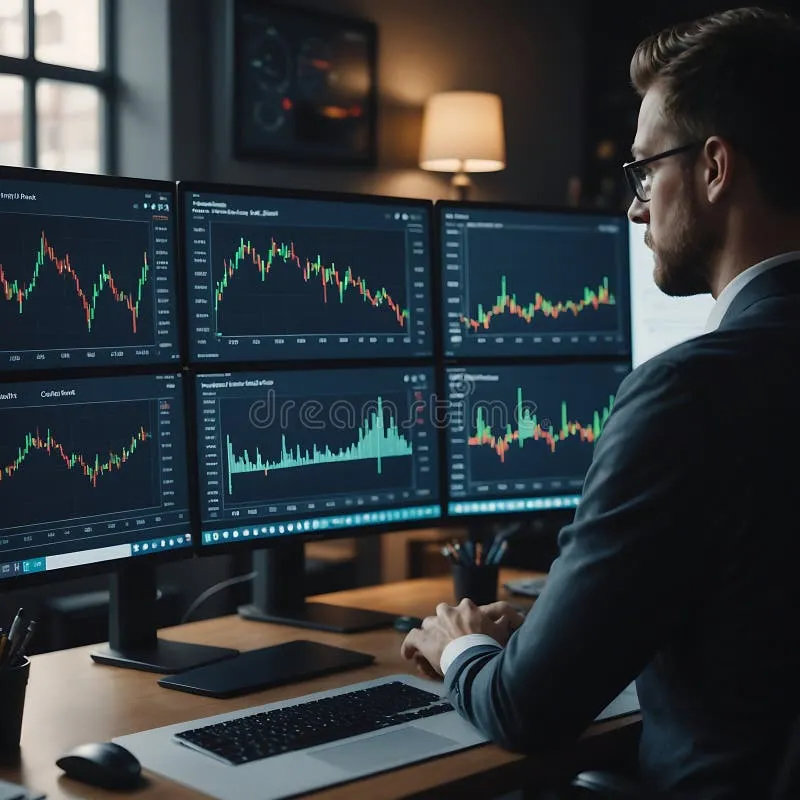
Photo: investor overwhelmed by multiple financial screens data overload trading desk, via images.stockcake.com
There is a seductive logic to the idea that better-informed investors make better decisions. For decades, retail participants operated at a structural disadvantage relative to institutional desks that had access to proprietary research, real-time feeds, and dedicated analysts. Today, that gap has narrowed considerably. A self-directed investor in Des Moines can monitor satellite imagery of retail parking lots, track credit card transaction data, and receive AI-curated earnings previews—all before the opening bell.
And yet, by multiple measures, retail trading outcomes have not improved proportionally. The paradox is not that information is unhelpful. It is that beyond a certain threshold, additional data begins to degrade the quality of judgment rather than enhance it.
The Cognitive Architecture of Overload
Human decision-making was not engineered for environments of continuous, high-velocity information. Behavioral economists have long documented that as the number of variables in a decision increases, individuals do not become more precise—they become more susceptible to heuristic shortcuts, confirmation bias, and recency effects.
In a trading context, this manifests in predictable ways. An investor monitoring fifteen data streams simultaneously may anchor to whichever source most recently confirmed a pre-existing thesis. Another may freeze entirely under the weight of conflicting signals, defaulting to inaction or, conversely, to impulsive action simply to resolve the discomfort of ambiguity.
The financial technology industry has, in many respects, monetized this vulnerability. Push notifications, real-time sentiment scores, and algorithmic alerts are engineered to generate engagement—not to improve portfolio outcomes. The investor who checks their brokerage app seventeen times per trading session is not a more disciplined participant; they are a more reactive one.
What the Research Actually Shows
Studies examining the relationship between information access and investment performance consistently point in the same direction. A landmark study by Barber and Odean found that the most active retail traders—those consuming the most market information and acting on it most frequently—underperformed their less active counterparts by a significant margin, largely due to transaction costs and poorly timed entries and exits.
More recent research on algorithmic alert systems suggests that while professional quantitative traders can extract value from high-frequency data, retail investors who attempt to replicate those strategies without the requisite infrastructure often experience the opposite effect: increased trading frequency, compressed holding periods, and degraded long-term returns.
The signal-to-noise ratio in modern financial data is not improving. It is deteriorating. Every new data source that becomes available to retail investors also becomes available to institutional desks with the computational resources to process it faster and more accurately. By the time a retail investor acts on a satellite-derived insight, it has typically already been priced in.
A Framework for Filtering Signal From Noise
The solution is not to retreat into information austerity. Relevant, well-filtered data remains essential to sound investment decisions. The discipline lies in matching data consumption to investment style and time horizon.
For long-term, fundamentals-driven investors, the data universe that genuinely matters is narrow: earnings reports, balance sheet trends, management commentary, competitive positioning, and macroeconomic regime indicators. Real-time tick data, intraday sentiment scores, and short-term technical signals are largely irrelevant to a thesis with a multi-year horizon—and actively harmful if they prompt premature position adjustments.
For active swing traders, technical structure, volume patterns, and sector rotation signals carry legitimate informational weight. Even here, however, selectivity is essential. Monitoring more than three to five primary indicators simultaneously tends to introduce conflict rather than clarity.
For income-oriented investors, credit quality metrics, dividend coverage ratios, and interest rate sensitivity are the core data points. Real-time equity volatility measures are a distraction.
The common thread across all styles is intentionality. Before consuming any data source, the disciplined investor should be able to articulate a specific decision it might influence and how. If the answer is vague—"it might tell me something useful"—the source is likely generating noise.
Building a Personal Data Diet
Practically speaking, constructing a sustainable information framework requires both addition and subtraction. Most investors will benefit more from eliminating low-quality data sources than from adding new ones.
Begin with an audit. For one week, track every data source you consult and note whether it influenced a specific decision. Most investors find that a significant portion of their information consumption produces no actionable output—it exists solely to satisfy the psychological need to feel informed.
Next, establish consumption windows. Rather than monitoring markets continuously throughout the trading session, designate specific times for data review. This practice reduces reactivity and allows for more deliberate synthesis of information before any decision is made.
Finally, apply a hierarchy of evidence. Primary sources—company filings, Federal Reserve statements, audited financial data—should carry more weight than derivative commentary. An analyst's interpretation of an earnings release is a step removed from the release itself; a financial influencer's interpretation of that analyst's note is two steps removed. Each layer of intermediation introduces potential distortion.
The Institutional Lesson
The most sophisticated institutional investors do not consume more data than their competitors. They consume better-curated data, applied with greater discipline. At ExBroker Group, we observe this distinction consistently: clients who establish clear investment theses, define the specific data points relevant to monitoring those theses, and resist the pull of extraneous information tend to demonstrate greater consistency and lower behavioral drag over time.
The retail investor who learns to treat data as a tool rather than a comfort mechanism is not operating with less information than their peers. They are operating with more precision—and in financial markets, precision is the variable that compounds.
The goal was never to know everything. It was always to know the right things, at the right time, in the right proportion. In an era of infinite data, that discipline has never been more valuable—or more difficult to maintain.